Blue-throated Keeled Lizard - Algyroides nigropunctatus

Scientific classification
Kingdom: Animalia
Phylum: Chordata
Subphylum: Vertebrata
Class: Reptilia
Order: Squamata
Suborder: Sauria
Infraorder: Scincomorpha
Family: Lacertidae
Genus: Algyroides
Species: Algyroides nigropunctatus
The blue-throated keeled lizard or Dalmatian algyroides (Algyroides nigropunctatus) is a species of lizard in the family Lacertidae.
Geographic range
A. nigropunctatus is found in Albania, Bosnia and Herzegovina, Croatia, Greece, Italy, the Republic of Macedonia, Montenegro, Serbia, and Slovenia.
Habitat
The natural habitats of A. nigropunctatus are Mediterranean-type shrubby vegetation, rocky areas, arable land, pastureland, plantations, rural gardens, and urban areas.
Description
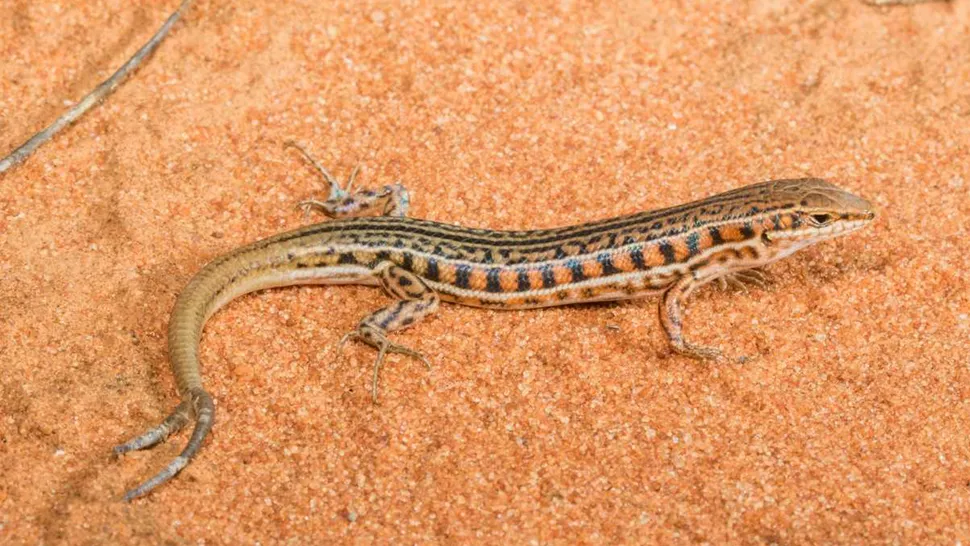
The maximum total length (including tail) is 25 cm (9.8 in) which makes it quite a lot bigger than any of the other Algyroides species. A. nigropunctatus can be recognized by the keeled V-shaped scales on the flanks, tail and back. It owes its common name to the bright blue throat of the males in the mating season. Sometimes also females get a blue throat that is less bright. The remainder of the body is light brown to rusty brown, the belly is white to yellowish. It owes its specific name, nigropunctatus, to the rows of black dots on the back. These dots are mostly missing in females outside the mating season.
Ecology
The blue-throated keeled lizard likes to climb. Its habitat consists of hedges, walls and ruins. The food consists of insects, worms, and other small invertebrates.
The animals are very easily frightened and are not often kept in captivity due to the protected status.
Reproduction
Only two or four eggs are laid, but it has been assumed that females can produce eggs both in early spring and early autumn. The males bite the females in the neck during mating and don't let go for quite some time which is common for Algyroides lizards.
Overachieving Lizard Grows Three Tails
Found recently in Kosovo, the unusual reptile is among only a handful of three-tailed vertebrates known to science, a new study says.

The blue-throated keeled lizard's three tails likely grew after its original tail was completely lost.
By James Owen, National Geographic
PUBLISHED SEPTEMBER 30, 2015
If the ability of some animals to regrow lost tails isn’t weird enough, a lizard has been found with three new tails in the place of one.
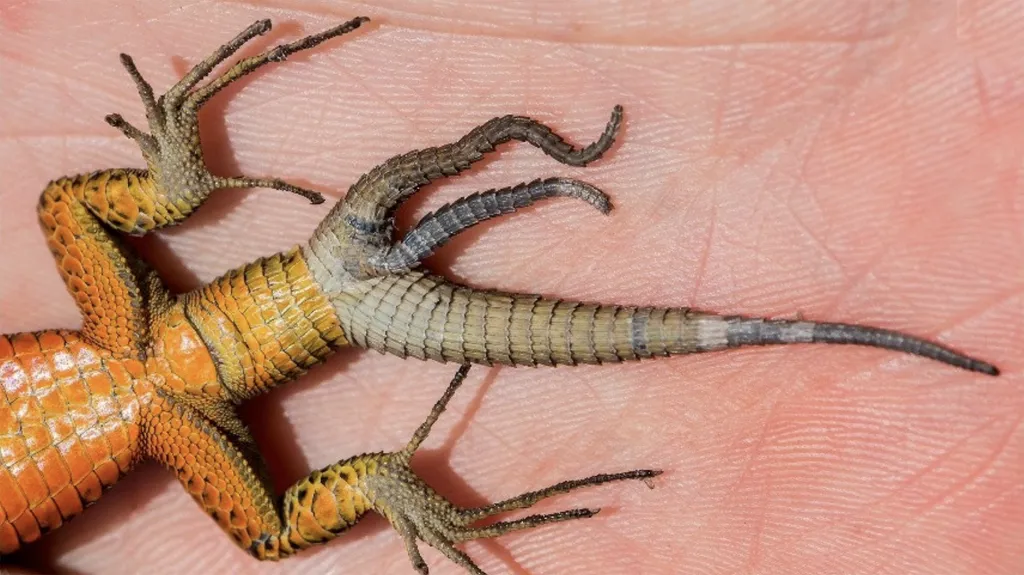
Spotted in June in the Metohija region of Kosovo, the adult blue-throated keeled lizard (Dalmatian algyroides) had tails that measured 30, 15, and 10 millimeters in length.
The freak individual, besides being a first known in the species, is among only a handful of triple-tailed lizards documented worldwide, according to its co-discoverer Daniel Jablonski, a biologist at Comenius University in Bratislava, Slovakia. Two-tailed specimens are more often seen—though are still relatively rare.
“I have been studying reptiles for a long time and examined hundreds or maybe thousands of specimens, but this was my very first” three-tailed lizard, he said via email.
Get Off My Tail!
The three tails are likely glitches in the lizard's autotomy, a self-amputation process in which species shed their tails to escape predators. The animals then regenerate a new tail by replacing the missing bone with cartilage.
Other vertebrates, including salamanders and tuataras—a reptile native to New Zealand—have replaceable tails, though they mostly occur in lizards.
Past studies of multi-tailed lizards suggest that an extra tail usually happens when the original tail is only partially severed and remains attached.
But in some cases, the extra appendages are formed after the entire tail is gone—as likely occurred with the Kosovo specimen.
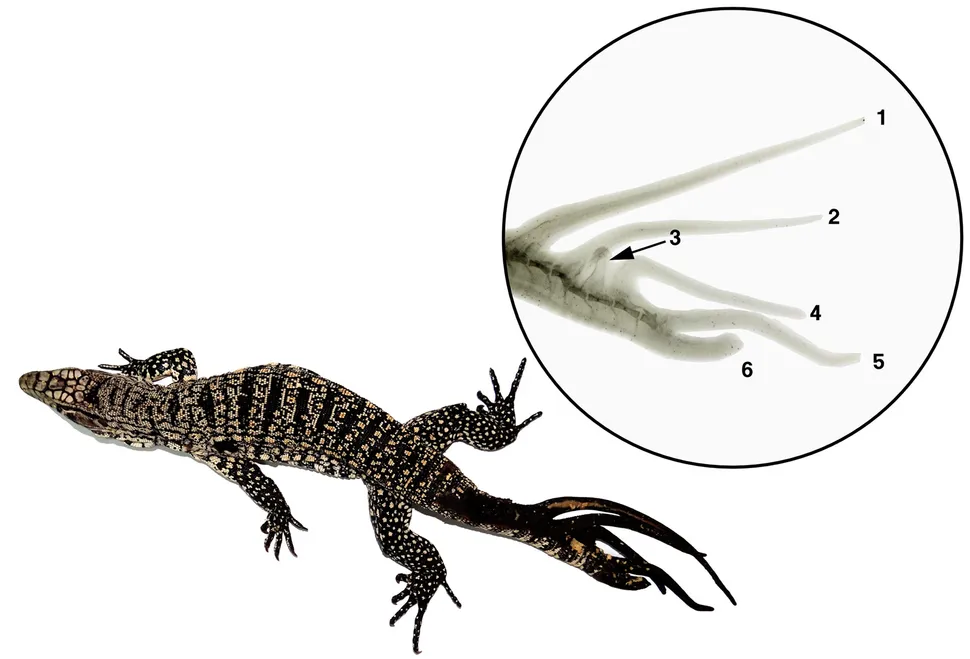
A crushing force likely fractured the base of the lizard's spine, causing a new tail to grow from each separated vertebra, according to the study, published in August in the journal Ecologica Montenegrina. A bird of prey or a dog may have attacked the animal—feral dogs “are pretty common in the Balkans,” notes Jablonski.
Supporting the theory that the lizard lost its old tail completely, its new tails have different colors and scaling patterns than the skin where the break occurred.
"Pretty Dramatic"
“What is cool here is that the original tail has been lost, rather than being damaged and retained,” says Bill Bateman, a biologist at Curtin University in Perth, Australia.
Autotomy is an important escape tactic for many species, he said, “so it’s not surprising that odd events like this one occur," says Bateman, who wasn't involved in the study.
Even so, the Kosovo lizard is “pretty dramatic, as all three tails look like they have generated from a stump, and all of them look quite big.”
Bateman once saw specimens of brown anole lizards (Anolis sagre) in the U.S. with three tails, but "they [had] very short and undeveloped ‘tail-lets'” attached to the original tail, he says.
Healthy Freak
Having multiple tails may affect balance and pose other handicaps, but the newfound specimen was in good condition, according to the study, and released unharmed.

The three-tailed lizard seemed to be healthy and was released unharmed in its Kosovo habitat. PHOTOGRAPH BY DANIEL JABLONSKI
It's possible the lizard compensates for its abnormality by changing its behavior—ie. becoming more wary of predators and maintaining a smaller territory, Bateman suggests.
“I doubt there are any health costs associated with having extra tails,” he adds.
And after all, it's a pretty incredible offer: Three tails for the price of one.
http://news.nationalgeographic.com/2015/09/150928-tails-lizards-animals-science-regenerate/
Tail trifurcation recorded in Algyroides nigropunctatus (Duméril & Bibron, 1839)
DANIEL KOLESKA¹ & DANIEL JABLONSKI²*
The Dalmatian Algyroides, Algyroides nigropunctatus (Duméril & Bibron, 1839), is a diurnal lizard
belonging to the family Lacertidae. It occurs on the coasts of the Adriatic and Ionian seas from easternmost
part of Italy (Istria) to southern Greece (Sillero et al. 2014). This species inhabits coastal areas as well as
inland mountain regions, mainly in central-western Balkans (Albania, southern parts of Serbia/Kosovo –
Metohija, eastern Macedonia and eastern Montenegro; Ajtić et al. 2005, Urošević et al. 2015) which reflects
the strong influence of Mediterranean climate on these areas.
As other lacertid lizards, A. nigropunctatus uses caudal autotomy as widespread strategy to avoid
being predated (Bateman & Fleming 2009; Pafilis et al. 2009). Bifurcation or more rarely trifurcation of tail
is occasionally observed as a probable result of previous injury possibly caused by predation, not by
developmental tail deformity (Lynn 1950). There are several previous records of tail bifurcation in lacertid
lizards (e.g. Tamar et al. 2013; Dudek & Ekner-Grzyb 2014) and also in other families – e.g. Anguidae
(Conzendey et al. 2013) or Gekkonidae (Kumbar et al. 2011). Natural tail trifurcation in lizards seems to be
more exceptional as there is few records in available literature (e.g. Pheasey et al. 2014).
On June 7th 2015 between 11.00 h and 12.00 h of local time we recorded and captured an adult A.
nigropunctatus male (Fig. 1A) basking on a rocky place close to Dedaj village, Metohija, Serbia/Kosovo
(42.28528°N 20.55711°E, 332 m a.s.l., DM68 in the 10 x 10 UTM geographic coordinate grid system – new
locality record sensu Urošević et al. 2015). After a closer examination of the individual we found out that it
has trifurcated tail. The tail was trifurcated approximately 10 mm posterior to the cloaca (Fig. 1B, C). The
longest tail measured approximately 30 mm. The second longest tail measured approximately 15 mm with a
smaller third tail growing from its base and measuring approximately 10 mm. The individual was in good
condition without other deformities or injuries. As far as we know there are no other previously observed
cases of tail trifurcation in this species. Total number of individuals observed on the locality was two adults.
As expected, tail bifurcation or trifurcation is usually considered as a result of previous injury caused
by predation (Lynn 1950) and is probably relatively common deformity in species using tail autotomy. Most
frequently, a predator may cause an injury but the tail sometimes stays attached which subsequently causes
an incomplete caudal autotomy. This injury might be extensive enough to start the regeneration process and
growing of a new tail in the place of injury while the original tail stays attached (Dudek & Ekner-Grzyb
2014). However, our specimen seemed to have its original tail completely removed considering different
scalation on all of its regenerated tails (Fig. 1B, C). Alibardi (2010) describes an experiment leading into a
formation of supernumerary tail using autotransplantation of spinal cord and ependyma (for details see the
article). Spinal cord seems to be the essential element promoting the process of regeneration in
supernumerary tail formations in natural conditions in reptiles (Evans & Bellairs 1983). We cannot be sure
which one of the two mechanisms described above was present during formation of this specific tail
trifurcation and whether there were some other factors included. However considering findings of Alibardi
(2010) we expect that specimen we observed could have suffered a major crushing injury resulting in
fragmentation of the vertebrae and subsequent separation of individual regenerating tails. There are also
records of bifurcated tails of approximately even length (“twin” tails) (Mitchell et al. 2012; Cordes & Walker
2013) which may indicate complete loss of original tail as well. However, the specimen was not collected
and preserved therefore we cannot proceed with further examination by x-ray.
http://ecol-mne.com/wp-content/uploads/2014/09/KoleskaJablonski_EcolMont_326-28.pdf
Scientific classification
Kingdom: Animalia
Phylum: Chordata
Subphylum: Vertebrata
Class: Reptilia
Order: Squamata
Suborder: Sauria
Infraorder: Scincomorpha
Family: Lacertidae
Genus: Algyroides
Species: Algyroides nigropunctatus
The blue-throated keeled lizard or Dalmatian algyroides (Algyroides nigropunctatus) is a species of lizard in the family Lacertidae.
Geographic range
A. nigropunctatus is found in Albania, Bosnia and Herzegovina, Croatia, Greece, Italy, the Republic of Macedonia, Montenegro, Serbia, and Slovenia.
Habitat
The natural habitats of A. nigropunctatus are Mediterranean-type shrubby vegetation, rocky areas, arable land, pastureland, plantations, rural gardens, and urban areas.
Description
The maximum total length (including tail) is 25 cm (9.8 in) which makes it quite a lot bigger than any of the other Algyroides species. A. nigropunctatus can be recognized by the keeled V-shaped scales on the flanks, tail and back. It owes its common name to the bright blue throat of the males in the mating season. Sometimes also females get a blue throat that is less bright. The remainder of the body is light brown to rusty brown, the belly is white to yellowish. It owes its specific name, nigropunctatus, to the rows of black dots on the back. These dots are mostly missing in females outside the mating season.
Ecology
The blue-throated keeled lizard likes to climb. Its habitat consists of hedges, walls and ruins. The food consists of insects, worms, and other small invertebrates.
The animals are very easily frightened and are not often kept in captivity due to the protected status.
Reproduction
Only two or four eggs are laid, but it has been assumed that females can produce eggs both in early spring and early autumn. The males bite the females in the neck during mating and don't let go for quite some time which is common for Algyroides lizards.
Overachieving Lizard Grows Three Tails
Found recently in Kosovo, the unusual reptile is among only a handful of three-tailed vertebrates known to science, a new study says.
The blue-throated keeled lizard's three tails likely grew after its original tail was completely lost.
By James Owen, National Geographic
PUBLISHED SEPTEMBER 30, 2015
If the ability of some animals to regrow lost tails isn’t weird enough, a lizard has been found with three new tails in the place of one.
Spotted in June in the Metohija region of Kosovo, the adult blue-throated keeled lizard (Dalmatian algyroides) had tails that measured 30, 15, and 10 millimeters in length.
The freak individual, besides being a first known in the species, is among only a handful of triple-tailed lizards documented worldwide, according to its co-discoverer Daniel Jablonski, a biologist at Comenius University in Bratislava, Slovakia. Two-tailed specimens are more often seen—though are still relatively rare.
“I have been studying reptiles for a long time and examined hundreds or maybe thousands of specimens, but this was my very first” three-tailed lizard, he said via email.
Get Off My Tail!
The three tails are likely glitches in the lizard's autotomy, a self-amputation process in which species shed their tails to escape predators. The animals then regenerate a new tail by replacing the missing bone with cartilage.
Other vertebrates, including salamanders and tuataras—a reptile native to New Zealand—have replaceable tails, though they mostly occur in lizards.
Past studies of multi-tailed lizards suggest that an extra tail usually happens when the original tail is only partially severed and remains attached.
But in some cases, the extra appendages are formed after the entire tail is gone—as likely occurred with the Kosovo specimen.
A crushing force likely fractured the base of the lizard's spine, causing a new tail to grow from each separated vertebra, according to the study, published in August in the journal Ecologica Montenegrina. A bird of prey or a dog may have attacked the animal—feral dogs “are pretty common in the Balkans,” notes Jablonski.
Supporting the theory that the lizard lost its old tail completely, its new tails have different colors and scaling patterns than the skin where the break occurred.
"Pretty Dramatic"
“What is cool here is that the original tail has been lost, rather than being damaged and retained,” says Bill Bateman, a biologist at Curtin University in Perth, Australia.
Autotomy is an important escape tactic for many species, he said, “so it’s not surprising that odd events like this one occur," says Bateman, who wasn't involved in the study.
Even so, the Kosovo lizard is “pretty dramatic, as all three tails look like they have generated from a stump, and all of them look quite big.”
Bateman once saw specimens of brown anole lizards (Anolis sagre) in the U.S. with three tails, but "they [had] very short and undeveloped ‘tail-lets'” attached to the original tail, he says.
Healthy Freak
Having multiple tails may affect balance and pose other handicaps, but the newfound specimen was in good condition, according to the study, and released unharmed.
The three-tailed lizard seemed to be healthy and was released unharmed in its Kosovo habitat. PHOTOGRAPH BY DANIEL JABLONSKI
It's possible the lizard compensates for its abnormality by changing its behavior—ie. becoming more wary of predators and maintaining a smaller territory, Bateman suggests.
“I doubt there are any health costs associated with having extra tails,” he adds.
And after all, it's a pretty incredible offer: Three tails for the price of one.
http://news.nationalgeographic.com/2015/09/150928-tails-lizards-animals-science-regenerate/
Tail trifurcation recorded in Algyroides nigropunctatus (Duméril & Bibron, 1839)
DANIEL KOLESKA¹ & DANIEL JABLONSKI²*
The Dalmatian Algyroides, Algyroides nigropunctatus (Duméril & Bibron, 1839), is a diurnal lizard
belonging to the family Lacertidae. It occurs on the coasts of the Adriatic and Ionian seas from easternmost
part of Italy (Istria) to southern Greece (Sillero et al. 2014). This species inhabits coastal areas as well as
inland mountain regions, mainly in central-western Balkans (Albania, southern parts of Serbia/Kosovo –
Metohija, eastern Macedonia and eastern Montenegro; Ajtić et al. 2005, Urošević et al. 2015) which reflects
the strong influence of Mediterranean climate on these areas.
As other lacertid lizards, A. nigropunctatus uses caudal autotomy as widespread strategy to avoid
being predated (Bateman & Fleming 2009; Pafilis et al. 2009). Bifurcation or more rarely trifurcation of tail
is occasionally observed as a probable result of previous injury possibly caused by predation, not by
developmental tail deformity (Lynn 1950). There are several previous records of tail bifurcation in lacertid
lizards (e.g. Tamar et al. 2013; Dudek & Ekner-Grzyb 2014) and also in other families – e.g. Anguidae
(Conzendey et al. 2013) or Gekkonidae (Kumbar et al. 2011). Natural tail trifurcation in lizards seems to be
more exceptional as there is few records in available literature (e.g. Pheasey et al. 2014).
On June 7th 2015 between 11.00 h and 12.00 h of local time we recorded and captured an adult A.
nigropunctatus male (Fig. 1A) basking on a rocky place close to Dedaj village, Metohija, Serbia/Kosovo
(42.28528°N 20.55711°E, 332 m a.s.l., DM68 in the 10 x 10 UTM geographic coordinate grid system – new
locality record sensu Urošević et al. 2015). After a closer examination of the individual we found out that it
has trifurcated tail. The tail was trifurcated approximately 10 mm posterior to the cloaca (Fig. 1B, C). The
longest tail measured approximately 30 mm. The second longest tail measured approximately 15 mm with a
smaller third tail growing from its base and measuring approximately 10 mm. The individual was in good
condition without other deformities or injuries. As far as we know there are no other previously observed
cases of tail trifurcation in this species. Total number of individuals observed on the locality was two adults.
As expected, tail bifurcation or trifurcation is usually considered as a result of previous injury caused
by predation (Lynn 1950) and is probably relatively common deformity in species using tail autotomy. Most
frequently, a predator may cause an injury but the tail sometimes stays attached which subsequently causes
an incomplete caudal autotomy. This injury might be extensive enough to start the regeneration process and
growing of a new tail in the place of injury while the original tail stays attached (Dudek & Ekner-Grzyb
2014). However, our specimen seemed to have its original tail completely removed considering different
scalation on all of its regenerated tails (Fig. 1B, C). Alibardi (2010) describes an experiment leading into a
formation of supernumerary tail using autotransplantation of spinal cord and ependyma (for details see the
article). Spinal cord seems to be the essential element promoting the process of regeneration in
supernumerary tail formations in natural conditions in reptiles (Evans & Bellairs 1983). We cannot be sure
which one of the two mechanisms described above was present during formation of this specific tail
trifurcation and whether there were some other factors included. However considering findings of Alibardi
(2010) we expect that specimen we observed could have suffered a major crushing injury resulting in
fragmentation of the vertebrae and subsequent separation of individual regenerating tails. There are also
records of bifurcated tails of approximately even length (“twin” tails) (Mitchell et al. 2012; Cordes & Walker
2013) which may indicate complete loss of original tail as well. However, the specimen was not collected
and preserved therefore we cannot proceed with further examination by x-ray.
http://ecol-mne.com/wp-content/uploads/2014/09/KoleskaJablonski_EcolMont_326-28.pdf